

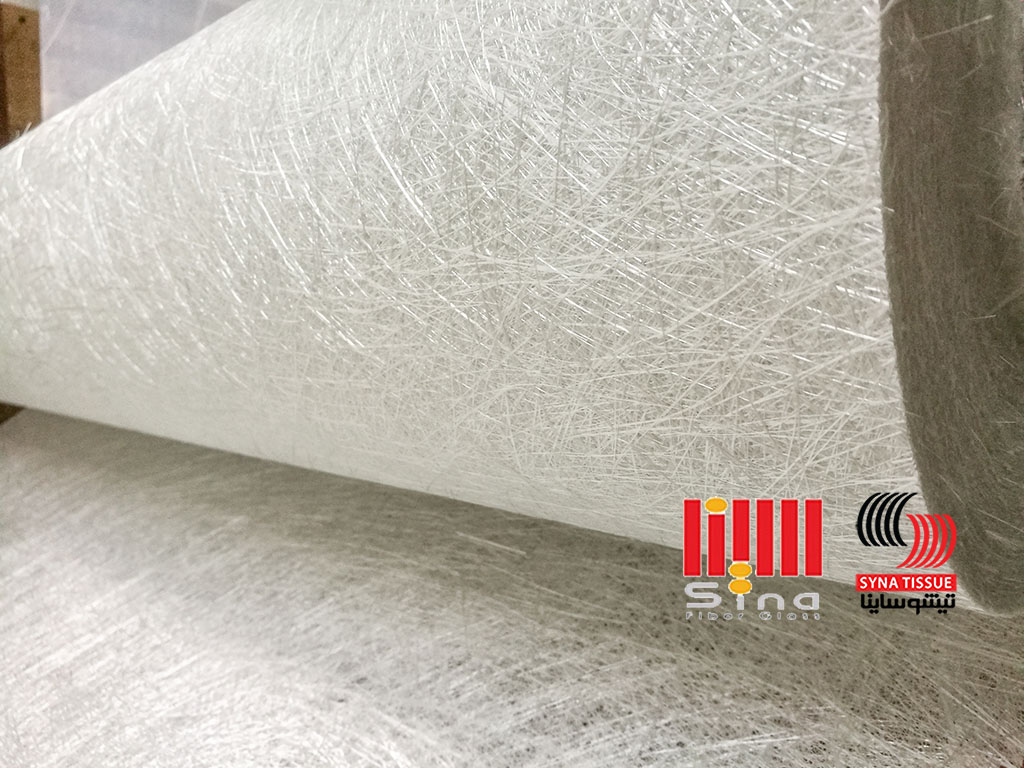
Chopped strand mat (CSM) is the most widely used glass reinforcement in hand lay-up and many other composite processes. It comes in two main binder types: powder and emulsion. The binder holds the chopped fibers together in the roll, and it decides how the mat drapes, how fast it wets out and which processes it suits. This guide explains the difference and how to choose.
What is chopped strand mat?
CSM is made of glass strands cut to a length of about 50 mm and spread randomly in a flat layer, then bonded with a binder. Because the fibers lie in all directions in the plane, it gives roughly equal strength in every direction. It is used in GRP/FRP pipes and tanks, boats, panels, cooling towers and sanitary ware, and it is usually combined with woven roving or surfacing tissue.
Powder vs emulsion binder at a glance
Powder chopped strand mat
- The binder is a thermoplastic polyester powder, melted onto the fibers during production.
- It dissolves quickly in the styrene of polyester resin, so the mat wets out fast and becomes soft and conformable.
- It drapes well over curves, corners and complex molds, which makes it the usual choice for hand lay-up and spray-up molded parts.
Emulsion chopped strand mat
- The binder is applied as a liquid emulsion and dried, usually a polyvinyl acetate type.
- It dissolves more slowly, so wet-out is slower and the mat keeps its shape longer in the resin.
- It is stiffer and easier to handle, and it suits flat or gently curved parts, press molding and continuous processes.
How the two compare
- Wet-out speed: powder is faster; emulsion is slower.
- Drape on complex shapes: powder is better; emulsion is stiffer.
- Handling and cutting: emulsion holds together better and sheds fewer loose fibers.
- Typical processes: powder for hand lay-up and complex molds; emulsion for flat panels, press molding and some continuous lamination.
- Resin compatibility: both are made for unsaturated polyester and vinyl ester; always confirm for your resin and process with a sample.
These are general guidelines. Actual behavior depends on the binder, the weight of the mat and the resin, so test a sample on your own line.
How to choose
- Look at the part geometry: deep curves and corners point to powder; flat or simple shapes point to emulsion.
- Look at the process: hand lay-up and fast cycles favor powder; press molding and continuous lines often favor emulsion.
- Choose the weight per area (commonly 225, 300, 450 or 600 g/m²) from the laminate thickness you need.
- Confirm the resin system and ask the supplier for a datasheet.
- Run a trial roll before switching production.
Chopped strand mat from Syna Tissue
Syna Tissue, part of Sina Fiber Glass (Rahavard Sina Delijan Co.), produces both powder and emulsion chopped strand mat, together with surfacing tissue, stitched mat, combo mat, woven roving and roving. Contact us for datasheets, samples and prices.
FAQ
Which is stronger, powder or emulsion CSM?
For the same weight and resin, the finished laminate strength is similar. The practical difference is in handling, wet-out and conformability, not in the final strength.
Can I use CSM with epoxy resin?
Standard CSM binders are designed for polyester and vinyl ester. Epoxy needs a compatible binder, so ask your supplier before using it.