

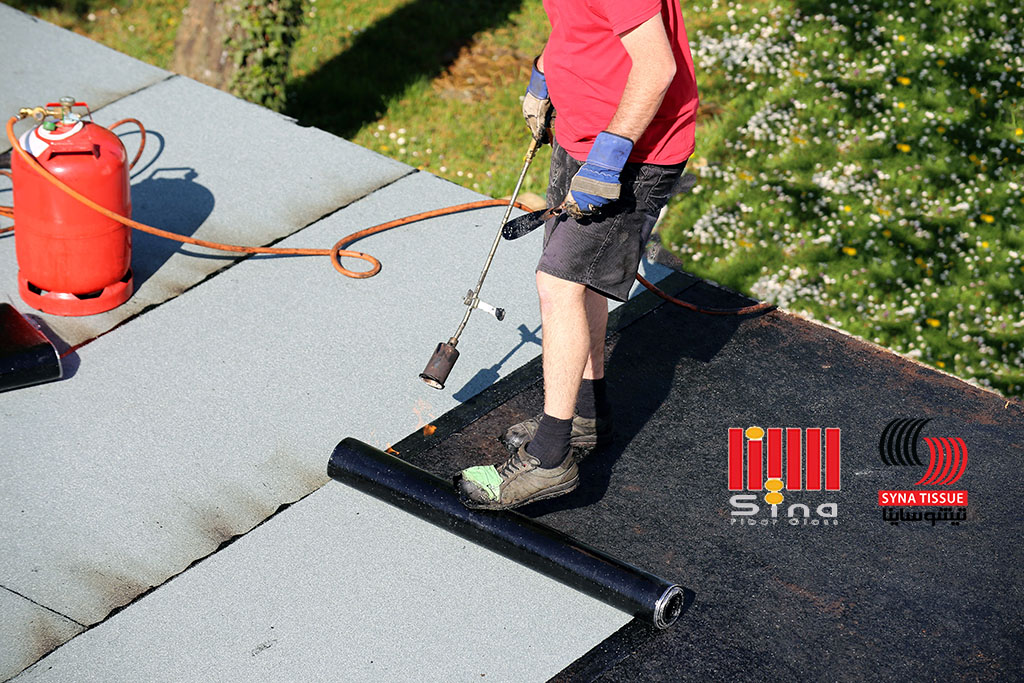
Roofing tissue is a glass fiber nonwoven mat used as the reinforcing carrier inside bitumen waterproofing membranes and bituminous shingles. The mat is impregnated and coated with bitumen, and its properties decide how stable, strong and easy to install the finished membrane is. This guide explains what roofing tissue does and how to choose the right grammage and specification.
What is roofing tissue?
Roofing tissue is made like other glass veils: fine glass filaments are dispersed in water, formed into a uniform web, treated with a binder and dried into rolls. For roofing, the mat has to hold together on a membrane line, absorb the right amount of bitumen and stay flat while it is coated, cooled and rolled.
What it does in a bitumen membrane
- Dimensional stability: glass does not stretch or shrink with heat, so the membrane keeps its size during coating and in service.
- Strength during production and installation: the mat carries the load through the coating line and resists tearing when the membrane is unrolled and torched or bonded.
- Rot and moisture resistance: glass does not rot or absorb water as organic felts do.
- Uniform bitumen uptake: a consistent web gives an even coating and a flat surface.
Roofing tissue is used alone or combined with polyester or other carriers, depending on the elongation and puncture resistance required. Glass gives stability; polyester gives more stretch. The right carrier depends on the membrane specification.
Key properties to compare
- Weight per unit area (g/m²): affects strength, bitumen uptake and cost. Check the tolerance.
- Tensile strength: machine and cross direction, which must suit your line tension.
- Binder type and content: influence stiffness, tensile strength and compatibility with hot bitumen.
- Uniformity and porosity: decide how evenly bitumen penetrates.
- Roll width and length: match your membrane line to avoid trimming waste.
How to choose
- Start from the membrane specification: type of bitumen (oxidized or modified, APP or SBS), required tensile strength and thickness.
- Choose the carrier: glass tissue for stability, polyester or a composite where more elongation is needed.
- Choose the grammage that gives the required strength with acceptable bitumen consumption.
- Check that the binder is suitable for your coating temperature.
- Request a datasheet and a trial roll, and test it on your line before changing production.
These are general guidelines. Final specifications should follow your product standards and test results.
Roofing tissue from Syna Tissue
Syna Tissue, part of Sina Fiber Glass (Rahavard Sina Delijan Co.), produces roofing tissue in custom widths and grammages, together with surfacing and wrapping tissue, and exports to customers in Asia, Europe and Africa. Contact us for datasheets, samples and prices.
FAQ
Is roofing tissue different from surfacing tissue?
Yes. They are made in the same way but specified differently. Roofing tissue is chosen for tensile strength and bitumen uptake in membranes; surfacing tissue is chosen for smooth, resin-rich surface layers in composites.
Can I order a custom grammage or width?
Yes. Custom widths and grammages are produced to order. Send us your requirements.