

Surfacing tissue (also called surfacing veil or overlay veil) and gelcoat are both used on the outer or inner face of a composite part, so they are often confused. They do different jobs, and in many laminates they are used together. This guide explains what each one does, where they differ and when you need one, the other or both.
What each layer does
Gelcoat
Gelcoat is a pigmented, unreinforced resin applied to the mold first, usually 0.4 to 0.6 mm thick. It gives the part its colour, gloss and first line of defence against weather, UV and abrasion. It is a coating, not a reinforcement.
Surfacing tissue
Surfacing tissue is a thin glass veil, commonly 20 to 50 g/m², laid behind the gelcoat or against the mold in an inner liner. Saturated with resin, it forms a resin-rich, lightly reinforced layer between the surface and the structural laminate. It hides the pattern of the heavier reinforcement behind it, spreads stress and helps stop cracks reaching the surface.
Key differences
- Role: gelcoat is a decorative and protective coating; tissue is a reinforced, resin-rich barrier layer.
- Reinforcement: gelcoat has none; tissue carries a fine glass network.
- Thickness: gelcoat is applied as a film; tissue is a roll good that sets the thickness of the resin-rich layer.
- Main benefit: gelcoat gives appearance and weathering resistance; tissue gives print-through control and crack resistance, and in chemical service a smooth, resin-rich corrosion barrier.
- Handling: gelcoat is sprayed or brushed; tissue is laid by hand or machine and wetted out.
When to use each
- Visible, coloured surface (boats, panels, sanitary ware): use gelcoat, with a tissue layer behind it to reduce fibre print-through and cracking.
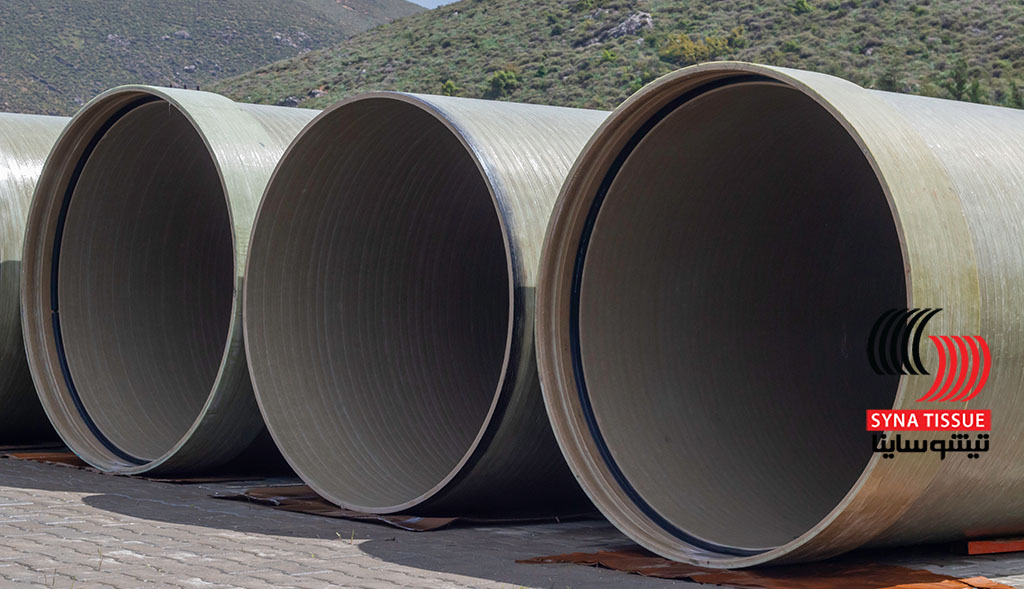
- Chemical or corrosive service (GRP/FRP pipes, tanks, ducts): use a resin-rich liner built from surfacing tissue, often topped with a light layer of chopped strand mat. Gelcoat is not the corrosion barrier here.
- Hidden or purely structural surface: tissue alone, or neither, depending on the specification.
- Tight finish tolerance: use tissue to even out the surface before painting or coating.
Choosing the right surfacing tissue
- Weight: lighter veils give a thinner, smoother layer; heavier ones hold more resin.
- Glass type: E-glass is the general-purpose choice; ECR glass resists acids better.
- Binder and resin compatibility: make sure the binder dissolves properly in your resin.
- Roll width: match your mold or winding line to avoid trimming waste.
These are general guidelines. Always check the part specification and run a sample.
Surfacing tissue from Syna Tissue
Syna Tissue, part of Sina Fiber Glass (Rahavard Sina Delijan Co.), produces surfacing tissue in custom widths and grammages and exports to customers in Asia, Europe and Africa. Contact us for datasheets, samples and prices.
FAQ
Can surfacing tissue replace gelcoat?
Not when you need colour and weather resistance on a visible face; that is gelcoat’s job. In internal chemical-resistant liners, a resin-rich tissue layer is used instead of gelcoat.
Do I need tissue if I already use gelcoat?
Often yes. A tissue layer behind the gelcoat reduces fibre print-through and helps prevent surface cracking.